





| Place of Origin: | CHINA |
|---|---|
| Brand Name: | HELLOSIGNAL® OR OEM |
| Minimum Order Quantity: | 50pcs |
| Packaging Details: | 10 PC / Plastic Bag |
| Delivery Time: | Normally 25 days after received the deposit. |
| Payment Terms: | T/T |
| Supply Ability: | no limit |
| Fiber Diameter: | 9/125um | Insertion Loss: | SM(G657A1)<1.0dB |
|---|---|---|---|
| Return Loss: | SM>50dB | Insert-pull Test: | Above 600 Times, IL<0.5dB |
| Operating Temperature (℃): | -40℃~ +80℃ | ||
| Highlight: | 8 Fibers MTP Loopback Cable,Singlemode Fiber Optic Loopback,40/100G Network Testing MTP Module |
||
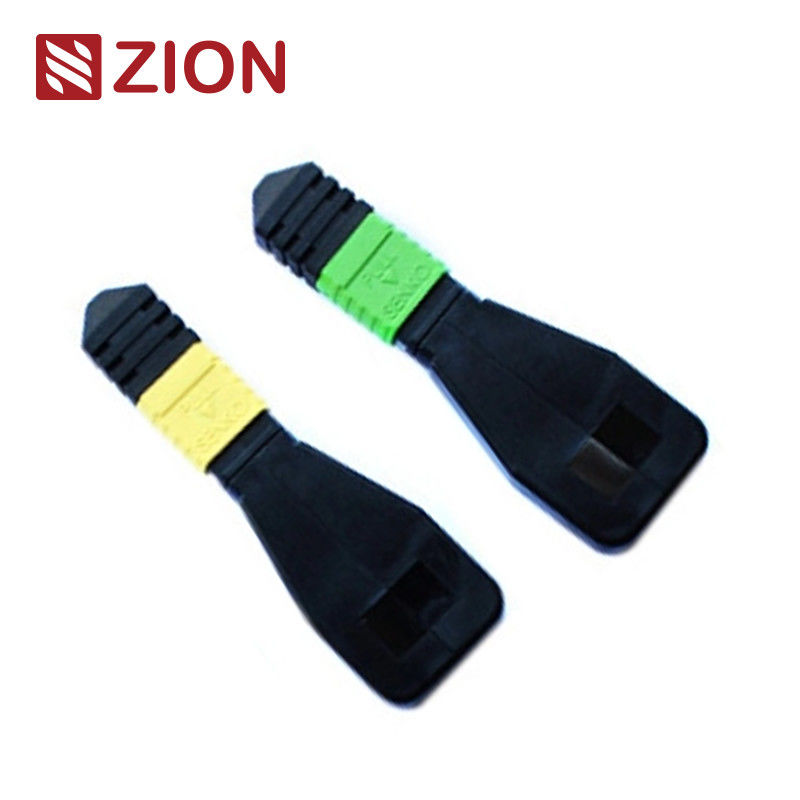
The MTP loopback contains MPO back ring jumping lines in the LOOPBACK configuration, with both ends of the fiber terminated in an MPO connector to create a complete light path within the same connector. This design enables testing of device launch capacity and receiving sensitivity, particularly in 40/100G network communications. By returning signals, it helps locate various potential issues and facilitates effective testing and evaluation of individual components or interfaces within fiber optic networks.
Available in multiple optical fiber circuit configurations to accommodate 8-core, 12-core, and 24-core MPO connectors with various fiber configurations for comprehensive port testing:
MTP Loopback modules provide looped signals to test transmit and receiving functions. Widely used within testing environments, especially in parallel optics 40 and 100G networks. Loopbacks are engineered to link Transceivers (TX) and Receivers (RX) positions of MPO transceiver interfaces. MPO loopbacks facilitate and accelerate IL testing of optical network segments by connecting them to MPO trunks and patch leads.
MPO Singlemode Reference: IEC 61754-7
MPO Singlemode Housing Details:
MPO Multimode Reference: IEC 61754-7
MPO Multimode Housing Details:
| Fiber Type | Singlemode |
| Fiber Diameter | 9/125um |
| Insertion Loss | SM(G657A1)<1.0dB |
| Return Loss | SM>50dB |
| Insert-pull Test | Above 600 times, IL<0.5dB |
| Operation Temperature | -40℃~ +80℃ |
A loopback test involves sending a signal from a communication device and looping it back to the same device to verify proper functionality or troubleshoot defective network nodes. Optical loopbacks specifically verify the operational reliability of devices by routing the signal emitted from the transmit (Tx) end of an active component back to the receive (Rx) end of the same component using fiber optic loopback cables or modules.
Fiber optic loopback testing is commonly employed for checking fiber optic transceivers. Since transceivers have separate ports for receiving and transmitting light signals, testing these ports is essential for maintenance. The testing process routes the laser signal from the transmitter port back to the receiver port, then compares transmitted and received patterns to ensure they are identical and error-free.
When selecting a loopback for specific transceivers, consider connector type, polish type, and cable type. The following tables provide selection guidance for commonly used transceiver modules.
Our fiber optic cables are packaged in easily handled, well-protected containers labeled and marked by OMC as standard. Available carton sizes include 34×22×15 cm, 44×34×24 cm, and 54×39×34 cm. Carton selection depends on order quantity. Custom packaging options are available.
We offer comprehensive OEM/ODM services including: